Thursday, April 30, 2015

Strange gods around us 

Vanity is the excessive belief in one's own abilities or attractiveness to others. Prior to the 14th century it did not have such narcissistic undertones, and merely meant futility. The related term vainglory is now often seen as an archaic synonym for vanity, but originally meant boasting in vain, i.e. unjustified boasting although glory is now seen as having an exclusively positive meaning, the Latin term gloria (from which it derives) roughly means boasting, and was often used as a negative criticism.
Some people say that the use of profanity, in conversation, is a sign of a poor education or an unimaginative mind – these people have obviously not encountered some of the profanity that I have.  In my opinion, profanity can be an artform; not least the use of profanity itself.
From the choice of profanity to the timing and delivery, there is a lot of skill to the proper use of profanity.  Waiting to the count of three or four before appending the word “cock” or even “cunt” to a final statement is the verbal equivalent of delivering the killing blow to an argument – or at least teabagging an already defeated opponent.
People established some guidelines to help people figure out if their love of football is just a fun pastime or an unhealthy obsession. The following behaviors may signal that a fan is losing a grip on reality and becoming addicted:
-- Thinking about football while doing other things.
-- Becoming irritated when a game is interrupted.
-- Missing important family or other events to watch a game.
-- Becoming depressed, angry or violent when a certain team loses.
Sport experts concluded that someone who is demonstrating these types of behaviors should seek help for their addiction before it damages their relationships with people they care about. As with any other addiction, people who observe these behaviors in someone, he noted, should not be afraid to speak up about the problem.
"Ultimately this is a habit that needs to change, and moving forward means changing your behavior a little bit at a time,"
Materialism, at its simpler level, involves the focus on material "things" as opposed to that which is spiritual or intellectual in nature. We live in a world surrounded by and composed of matter. It is natural, therefore, that we may become distracted from spiritual or intellectual pursuits by material possessions, but this is frequently where problems occur. We can become obsessed by a desire to obtain them, or simply frustrated by the need to maintain them. 

Light and Color
The name of the three ways light interacts with matter is Transparent, Translucent, and Opaque. Transparent describes matter that allows light to pass through with little interference. Translucent decribes matter that transmit light but that does not transmit and image. Opaque decribes an object that does not transparent or translucent. We tend to think of objects as having fixed colors—an apple, for example, is red. In reality, an object’s appearance results from the way it reflects the particular light that is falling on it. Under white light, the apple appears red because it tends to reflect light in the red portion of the spectrum and absorb light of other wavelengths. If a filter is used to remove red from the light source, the apple reflects very little light and appears black.
 The fact that the color makeup of light can change, means that shifts can occur in the color appearance of objects illuminated by it. Within limits, the brain compensates for these changes in color appearance and we see things as we expect them to appear. But the changes are there nonetheless and can affect the way people respond to objects and environments. There is a great variety in the color makeup of light that appears white. Direct sunlight at noontime is an almost perfectly balanced light source—it contains all colors in nearly equal quantities. But daylight does experience color shifts.
The color appearance of objects changes dramatically in early morning or in the shade. Electric light sources can also exhibit variations in color makeup. Incandescent lamps tend to produce more red and yellow light than green and blue, and appear to be “warm” in color. Because of the way incandescent light is produced, little can be done to manipulate its color characteristics. With fluorescent and high intensity discharge lighting, this latest technology makes it possible to manipulate the color makeup of a given light source.Generally speaking, whiter light (comprised of equal amounts of all colors) makes colors appear more natural and vibrant. However, some portions of the spectrum are more important to a light’s color makeup than others. Red, blue and green—the primary colors of light—can be combined to create almost any other color. This suggests that a light source containing balanced quantities of red, blue and green light can provide excellent color appearance even if this light source is deficient in other colors in the spectrum.


Wednesday, April 29, 2015

1st and 2nd Commandments

This First Commandment sets the tone for the first four commandments, which can be summarized as, “You shall love the LORD your God with all your heart, with all your soul, and with all your strength” There are many pitfalls and temptations that can lead us to disobey the First Commandment. This commandment is not just about pagan gods and false religions. Anything that we put as higher priority than the true God causes us to sin.Pride, that common human failing, breaks this command by putting self above God. As James wrote: “But He gives more grace. Therefore He says: ‘God resists the proud, but gives grace to the humble.’ Therefore submit to God. Resist the devil and he will flee from you. Draw near to God and He will draw near to you. Cleanse your hands, you sinners; and purify your hearts, you double-minded. Lament and mourn and weep! Let your laughter be turned to mourning and your joy to gloom. Humble yourselves in the sight of the Lord, and He will lift you up” We need to seek God’s help to see things from God’s perspective—to get outside our own selfish worldview.

Though this second Commandment is closely related to the first, yet there is a clear distinction between them, which may be expressed in a variety of ways. As the first Commandment concerns the choice of the true God as our God, so the second tells of our actual profession of His worship; as the former fixes the Object so this fixes the mode of religious worship. As in the first commandment Jehovah had proclaimed Himself to be the true God, so here He reveals His nature and how He is to be honored."Thou shalt not make unto thee any graven image thou shalt not bow down thyself to them." This commandment strikes against a desire, or should we say a disease, which is deeply rooted in the human heart, namely, to bring in some aids to the worship of God, beyond those which He has appointed—material aids, things which can be perceived by the senses. Nor is the reason for this difficult to find: God is incorporeal, invisible, and can be realized only by a spiritual principle, and since that principle is dead in fallen man, he naturally seeks that which accords with his carnality. But how different is it with those who have been quickened by the Holy Spirit. No one who truly knows God as a living reality needs any images to aid his devotions; none who enjoys daily communion with Christ requires any pictures of Him to help him to pray and adore, for he conceives of Him by faith and not by fancy.
Interaction of  Light waves 

Refraction is the bending of a wave when it enters a medium where its speed is different. The refraction of light when it passes from a fast medium to a slow medium bends the light ray toward the normal to the boundary between the two media.As the speed of light is reduced in the slower medium, the wavelength is shortened proportionately. The frequency is unchanged; it is a characteristic of the source of the light and unaffected by medium changes.
The index of refraction is defined as the speed of light in vacuum divided by the speed of light in the medium.The indices of refraction of some common substances are given below with a more complete description of the indices for optical glasses given elsewhere. The values given are approximate and do not account for the small variation of index with light wavelength which is called dispersion.
Snell's Law relates the indices of refraction n of the two media to the directions of propagation in terms of the angles to the normal. Snell's law can be derived from Fermat's Principle or from the Fresnel Equations.Enter data and then click on the symbol for the quantity you wish to calculate in the active equation above. The numbers will not be forced to be consistent until you click on the quantity to calculate. Indices of refraction must be greater than or equal to 1, so values less than 1 do not represent a physically possible system.If the incident medium has the larger index of refraction, then the angle with the normal is increased by refraction. The larger index medium is commonly called the "internal" medium, since air with n=1 is usually the surrounding or "external" medium. You can calculate the condition for total internal reflection by setting the refracted angle = 90° and calculating the incident angle. Since you can't refract the light by more than 90°, all of it will reflect for angles of incidence greater than the angle which gives refraction at 90°.
 Visible light, also known as white light, consists of a collection of component colors. These colors are often observed as light passes through a triangular prism. Upon passage through the prism, the white light is separated into its component colors - red, orange, yellow, green, blue and violet. The separation of visible light into its different colors is known as dispersion. It was mentioned in the Light and Color unit that each color is characteristic of a distinct wave frequency; and different frequencies of light waves will bend varying amounts upon passage through a prism. In this unit, we will investigate the dispersion of light in more detail, pondering the reasons why different frequencies of light bend or refract different amounts when passing through the prism.
Earlier in this unit, the concept of optical density was introduced. Different materials are distinguished from each other by their different optical densities. The optical density is simply a measure of the tendency of a material to slow down light as it travels through it. As mentioned earlier, a light wave traveling through a transparent material interacts with the atoms of that material. When a light wave impinges upon an atom of the material, it is absorbed by that atom. The absorbed energy causes the electrons in the atom to vibrate. If the frequency of the light wave does not match the resonance frequency of the vibrating electrons, then the light will be reemitted by the atom at the same frequency at which it impinged upon it. The light wave then travels through the interatomic vacuum towards the next atom of the material. Once it impinges upon the next atom, the process of absorption and re-emission is repeated.The optical density of a material is the result of the tendency of the atoms of a material to maintain the absorbed energy of the light wave in the form of vibrating electrons before reemitting it as a new electromagnetic disturbance. Thus, while a light wave travels through a vacuum at a speed of c (3.00 x 10⁸ m/s), it travels through a transparent material at speeds less than c. The index of refraction value (n) provides a quantitative expression of the optical density of a given medium. Materials with higher index of refraction values have a tendency to hold onto the absorbed light energy for greater lengths of time before reemitting it to the interatomic void. The more closely that the frequency of the light wave matches the resonant frequency of the electrons of the atoms of a material, the greater the optical density and the greater the index of refraction. A light wave would be slowed down to a greater extent when passing through such a material.What was not mentioned earlier in this unit is that the index of refraction values are dependent upon the frequency of light. For visible light, the n value does not show a large variation with frequency, but nonetheless it shows a variation. For instance for some types of glass, the n value for frequencies of violet light is 1.53; and the n value for frequencies of red light is 1.51. The absorption and re-emission process causes the higher frequency (lower wavelength) violet light to travel slower through crown glass than the lower frequency (higher wavelength) red light. It is this difference in n value for the varying frequencies (and wavelengths) that causes the dispersion of light by a triangular prism. Violet light, being slowed down to a greater extent by the absorption and re-emission process, refracts more than red light. Upon entry of white light at the first boundary of a triangular prism, there will be a slight separation of the white light into the component colors of the spectrum. Upon exiting the triangular prism at the second boundary, the separation becomes even greater and ROYGBIV is observed in its splendor.

Tuesday, April 28, 2015

The Law of Reflection 
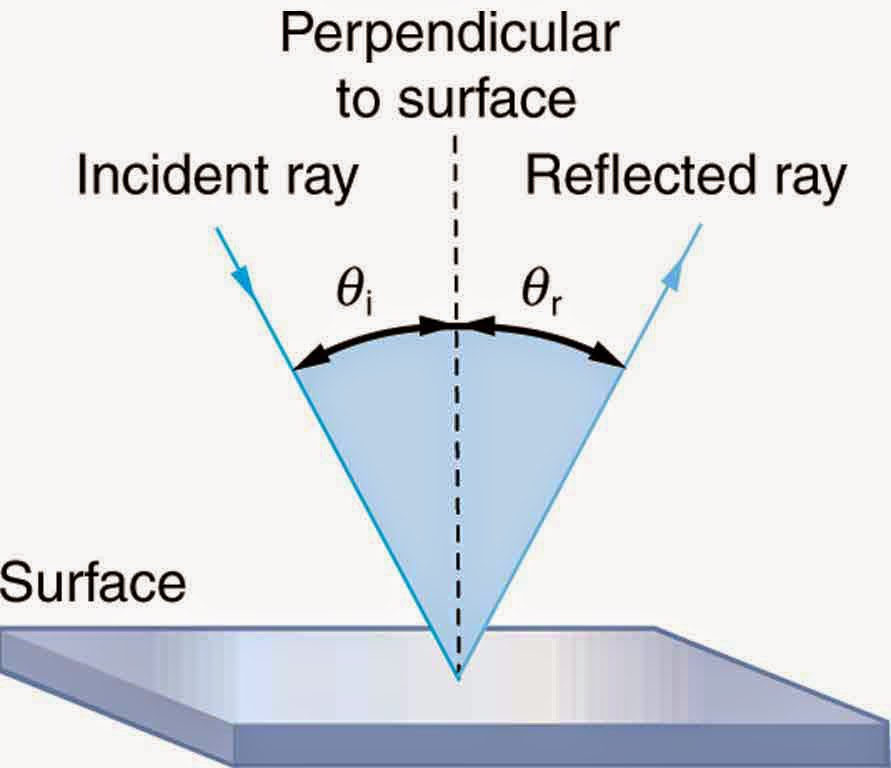
Light is known to behave in a very predictable manner. If a ray of light could be observed approaching and reflecting off of a flat mirror, then the behavior of the light as it reflects would follow a predictable law known as the law of reflection. The diagram below illustrates the law of reflection.
When a ray of light strikes a plane mirror, the light ray reflects off the mirror. Reflection involves a change in direction of the light ray. The convention used to express the direction of a light ray is to indicate the angle which the light ray makes with a normal line drawn to the surface of the mirror. The angle of incidence is the angle between this normal line and the incident ray; the angle of reflection is the angle between this normal line and the reflected ray. According to the law of reflection, the angle of incidence equals the angle of reflection. These concepts are illustrated in the animation below.
The law of reflection tells us that light reflects from objects in a very predictable manner. So the question is, why do we see objects like a table or a chair? These objects do not produce their own light, so in order for us to see any object, light must strike the object and reflect from the object into our eyes. More specifically, in order for us to be able to see objects, the light reflecting off an object must make its way directly to our eyes. So how does the light get from the object to our eyes? It does so through one of the two types of reflection: specular and diffuse reflection.


infrared, microwaves,x-rays &gamma rays

EM radiation is classified into types according to the frequency of the wave: these types include, in order of increasing frequency, radio waves, microwaves, infrared radiation, visible light, ultraviolet radiation, X-rays and gamma rays.EM radiation in the visible part of the spectrum is scattered off all of the objects around us. This EM radiation provides the information to our eyes that allows us to see. The frequencies of radiation the human eye is sensitive to constitute only a very small part of all possible frequencies of EM radiation. The full set of EM radiation is called the electromagnetic spectrum. To simplify things the EM spectrum divided into sections (such as radio, microwave, infrared, visible, ultraviolet, X-rays and gamma-rays).Gamma rays and X rays have too much energy to be captured, much of the time, and will pass through. But when they are absorbed, they cause a lot of damage, and so they're best avoided.

Monday, April 27, 2015

Ten Commandments 

God gave the 10 Commandments from Mount Sinai, accompanied by smoke, earthquakes and the blast of a trumpet to emphasize the importance of these laws. Moses recorded God’s words in Exodus 20 and recounted the event again
The Ten Commandments:
You shall have no other gods before Me.
You shall not make idols.
You shall not take the name of the LORD your God in vain.
Remember the Sabbath day, to keep it holy.
Honor your father and your mother.
You shall not murder.
You shall not commit adultery.
You shall not steal.
You shall not bear false witness against your neighbor.
You shall not covet.
The Ten Commandments (also known as the Decalogue) are ten laws in the Bible that God gave to the nation of Israel shortly after the exodus from Egypt. The Ten Commandments are essentially a summary of the 613 commandments contained in the Old Testament Law. The first four commandments deal with our relationship with God. The last six commandments deal with our relationships with one another
The Ten Commandments are an excellent piece of literature of the Old Testament, which was given by God Himself, through Moses, to the people of Israel, and which was destined to shape the morals of the society of the world.

The Ten Commandments, also known as the Decalogue, constitute the ethical code by which the human race is guided, on the one hand, to believe in the true God, and, on the other hand to sustain the godly society in the attainment and application of God's will on earth. The Ten Commandments were kept undefiled and handed down to us as a treasure and monument of Christian civilization. The Christian Church has embodied the Ten Commandments as a basic moral code of, discipline toward God and toward men. "There is probably no human document which has exercised a greater influence upon, religion and morals than the Ten Commandments."